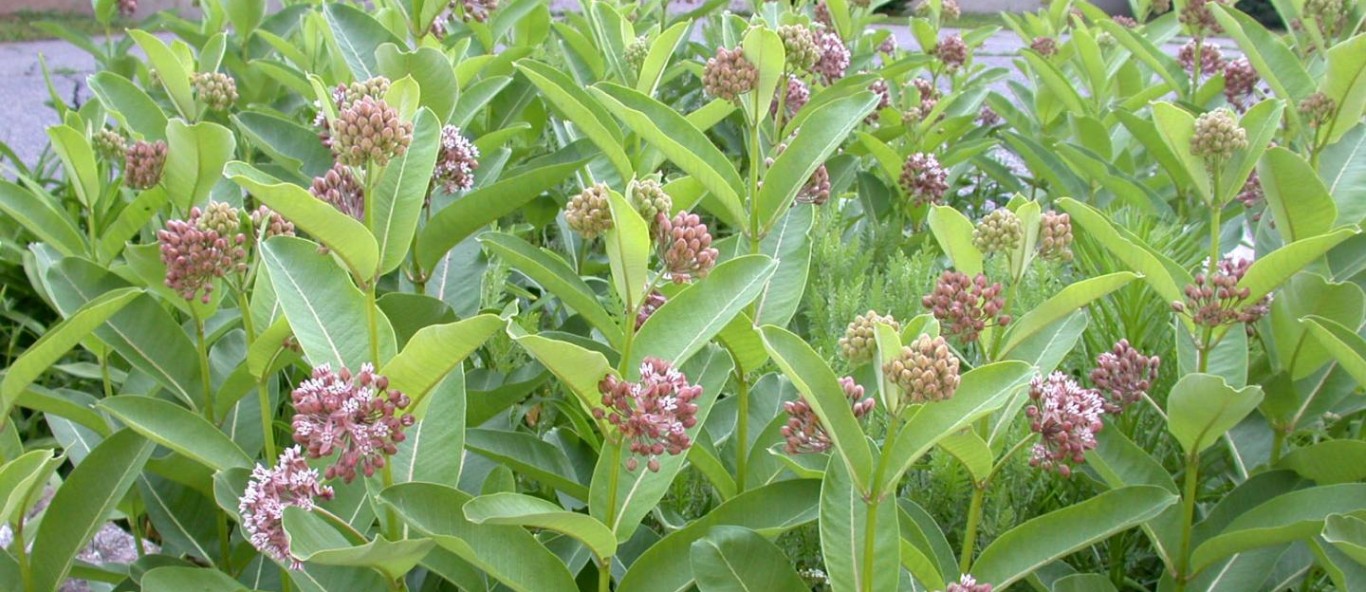
Common Milkweed
Common Milkweed (Asclepias syriaca)
Range: Asclepias syriaca is native to most of the eastern and central United States and southern Canada, thriving in a variety of open and disturbed habitats. This species is highly adaptable and often colonizes disturbed sites, including fence rows, roadsides, fields, pastures, and prairies.

Description & Impact: Common milkweed is a deciduous, herbaceous perennial in the Apocynaceae (dogbane) family, growing 2 to 5 feet tall with stout, reddish-green stems and broad, opposite leaves 4–8 inches long and 2–4 inches wide. The leaves are thick, smooth above, lighter and softly hairy beneath. When broken, stems and leaves leak a milky latex containing toxic cardiac glycosides, which deters herbivores. Since monarch caterpillars exclusively feed on the leaves of milkweed, it makes them and their adult butterfly form unpalatable to predators. From June through August, it produces fragrant, spherical clusters of 20–130 small flowers per cluster. Flower colors range from greenish-pink to purplish-pink. Common milkweed is critical for monarch butterflies, serving as the primary larval host plant across eastern North America. The flowers provide nectar for over 100 insect species, including bees, butterflies, hummingbirds, and other pollinators. It also supports milkweed-specific insects like the milkweed weevil and milkweed longhorn beetle.
Plant Medical History: Various tribes used milkweed for a range of ailments. The roots were commonly brewed into teas to relieve coughs, asthma-like symptoms, and bronchitis, acting as an expectorant and mild anti-inflammatory. They were also used for digestive disorders, including indigestion, bloating, and constipation, due to a mild laxative effect. For skin conditions, the milky sap was applied to warts, rashes, and ringworm, taking advantage of its natural antiviral and antifungal properties.
Cultivation & Garden Use: Common milkweed grows in USDA zones 3-9, preferring full sun and tolerating average to poor soils. The plant produces inflated seed pods 4 inches long, which split open to release 50–100 seeds each, equipped with a white, fluffy coma for easy wind dispersal. It propagates easily this way by seed. The plant also spreads via rhizomes, forming large colonies, making it suitable for naturalized areas, meadows, and pollinator gardens. Its spreading habit makes it ideal for large, naturalized areas, but less suitable for small, formal garden beds. Because it is toxic to humans and animals if ingested, proper placement is also important due to this vigorous spreading habit.