Conservation Land
The History of CFG’s Conservation Areas
Jumes Woods
- Acreage: 40
- Acquired in year: 2016
- Acquired from: Dr. Marvin & Patricia Jumes
The history of the Jumes Woods is paraphrased from the writings of Dr. Marvin Jumes’ youngest daughter, Elaine.
The story of the Jumes Woods starts with Dr. Marvin Jumes purchasing the original farmhouse from Raymand and Alvina Handrow in 1965. Dr. Jumes had served in the U.S. Air Force as Chief of Anesthesiology at Fairchild AFB in Spokane, WA. After practicing in Bend, OR, he had decided to return to his hometown of Sheboygan, WI at the age of 30. He joined the staff at Sheboygan Memorial and St. Nicholas hospitals and had been searching for a home for his family, when he happened upon the farmhouse near Mosel, WI. The Handrows graciously decided to “throw the land in” with the sale of the house. Dr. Jumes moved in with his wife, Helene and their four children: George, Paul, Deborah, and Elaine.
The property’s land originally totaled 62 acres. Due to the natural erosion of Lake Michigan, this number is less today. By his daughter Elaine’s account, Dr. Jumes was a real “do-it-yourselfer” and made many updates to the farmhouse and the land with the help of his family. The back forty acres are divided by a natural creek running through it, north to south, with a cement bridge on the north side of the property. Dr. Jumes later had a small pond put in, just west of the creek. It was dug out professionally and filled with water. Thus began the creation of an oasis on his land for his beloved dogs to run. And, before long, the local wildlife began arriving in droves to the sanctuary he was creating.
The Trees
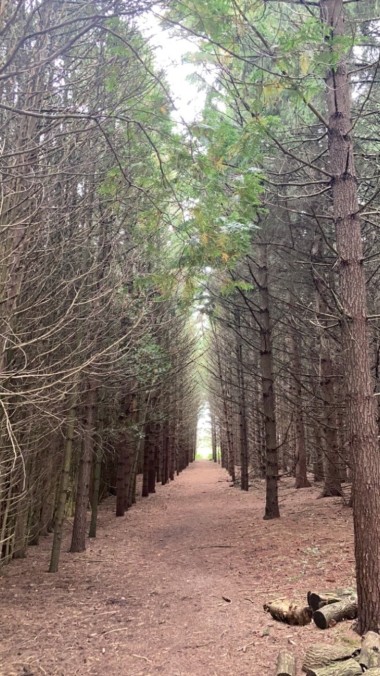 In the early ‘70s, Dr. Jumes contracted the Wisconsin DNR Forestry Division to plant 22,000 trees on the outside perimeters of all his fields. This was done in the spring with mechanical planters. Two years later, another 22,000 trees were planted inside of these perimeters. It’s likely that the trees, better known as “1-0 and 2-0 bare-root seedlings” came from a nursery in Wisconsin Rapids. The breakdown of the trees is: 79% Norway Spruce, 13% White Pine, 6% Black Walnut, and the remaining 2% represents the Blue Spruce embedded in the back forty’s northwest section.
Dr. Jumes put a lot of love into the land and his new trees. After working in surgery and making his rounds at the hospital, Marvin wouldn’t hesitate to jump on his riding lawn mower and cut the grass between the rows of trees. When they were first planted, he manually watered each tree using a series of hoses from the house, or water pumped from a 50-gallon container that he fixed to a small trailer that he pulled behind his riding lawn mower. He also dutifully fertilized the young seedlings by hand with liquid fish fertilizer. This was also quite the family affair! Immediately after the trees were planted, Dr. Jume’s tasked his sons with helping to care for the young saplings. This involved individually weeding each sapling by hand with utility blades. The boys were paid $1 dollar per row of trees. When the Jumes girls were old enough, they also joined in weeding around each tree.
Once the trees were tall enough, the Jumes family started selling Christmas trees. It was a natural way to thin some of the rows and it was something the family looked forward to each winter. People were allowed to walk the property and find the perfect Christmas tree, cut it down, drag it back, and be charged $3 per foot. The only caveat was that they would not cut the tree down to the ground but leave at least one whirl of branches on the tree stump. That would eventually regenerate into a new tree after a few years. They continued selling Christmas trees for about 10 years, and only discontinued business when majority of the trees became too tall and no longer suitable for indoor Christmas trees.
Dr. Jumes retired in 1998 after 37 years of Anesthesia practice. He enjoyed his retirement at the farmhouse with his second wife, Patricia. The two of them kept busy by cutting grass, splitting wood, constantly working on projects, walking the back forty with their beloved dogs, and of course, enjoying the magnificent trees and the land along the lake that they loved so dearly.
In December of 2016, the property was sold to Mr. Jay Christopher, who became intrigued by the uniqueness of this land that would happen to connect to his existing properties, when it went up for sale. Dr. Jumes passed on in January of 2018, though his legacy lives on through his children, his wife Patricia, and the land that he cared for so dearly. Today, Dr. Jumes’ trees tower high above your head when walking between their rows, creating an extraordinary habitat of evergreens along Lake Michigan. Mr. Christopher wishes to keep this land intact, as a conservation area, with no plans for development. It is instead protected as a peaceful haven - for wildlife to hide out among the trees’ dense branches during harsh winter storms; for the evergreens’ roots to hold fast the soil, preventing erosion along the lake’s high bluffs; and for the sake of ethically keeping a slice of lakeshore without development, for years to come.
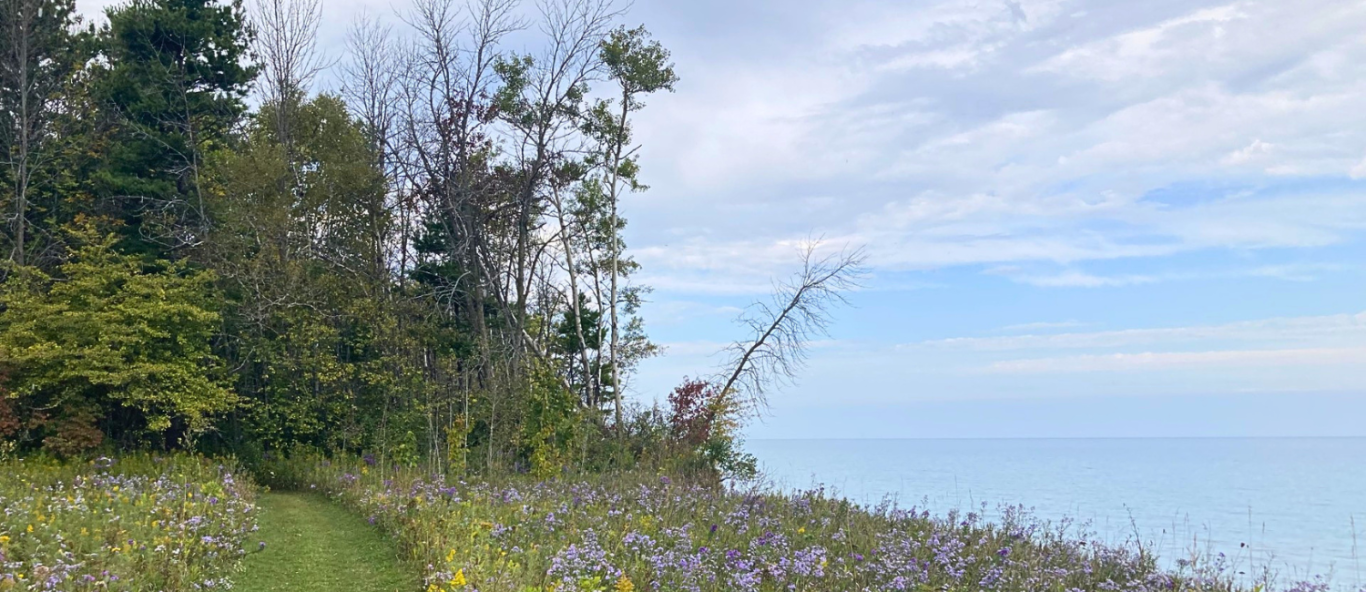
Bluff Path Buffer Prairies & Old-Growth Ravines
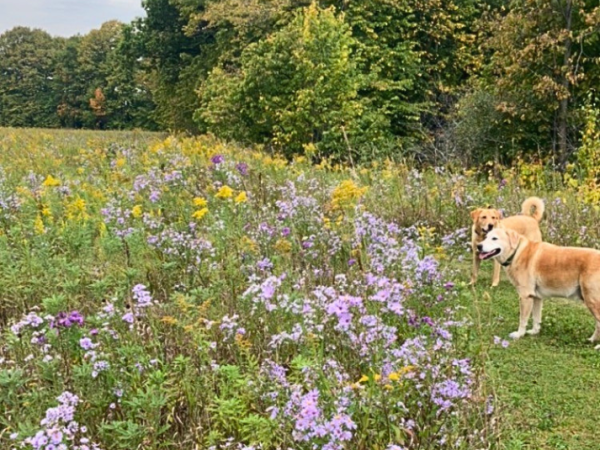 Between the main Christopher Farm & Gardens property and the Jumes Woods, several owned farm fields are leased annually to familiar farmers, who have been working the land and growing crops with us for years. These fields are buffered from Lake Michigan with tallgrass prairie strips, which are strategically seeded with native plants and managed for invasive species. These areas aid in preventing farm field run off from reaching the lake due to the prairie plants' ability to rapidly soak up excess water. These areas are also important for preventing washouts and additional erosion from occurring along the lakeshore.
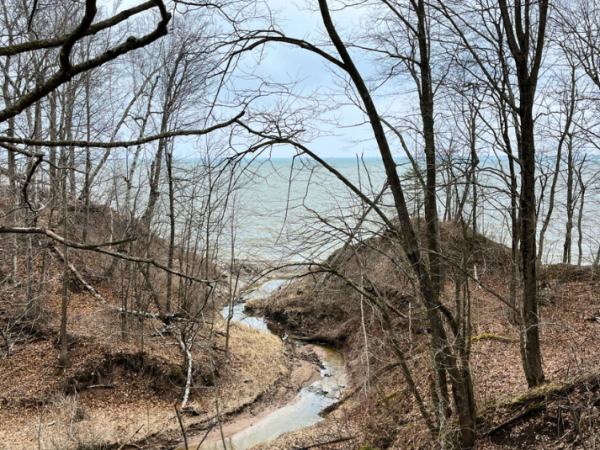 Along with these man-made buffer strips are a series of natural, old-growth ravines. These steeply pitched drainage areas were never able to be developed by farmers, so they naturally contain some of the oldest trees and diverse assortments of native plant species that exist in our area. In spring, ephemeral wildflowers can be seen playfully poking out from the understory along the ravines. This variety of plants are rare, known only to grow in certain types of deciduous forest environments. In fall, the bright blazes of sugar maple, oak and beech trees’ leaves paint a striking picture against the background of the vast lake. In winter, these ravines mark a haven for wildlife to take cover in, protecting them from the harsh elements of our coldest season. Preserving these natural habitats will help to maintain the balance and health of our local wildlife communities and will continue to be a goal of the Christopher Farm & Gardens mission.
Turkey Trot Trails
- Acreage: 15 acres
- Acquired in year: 2005
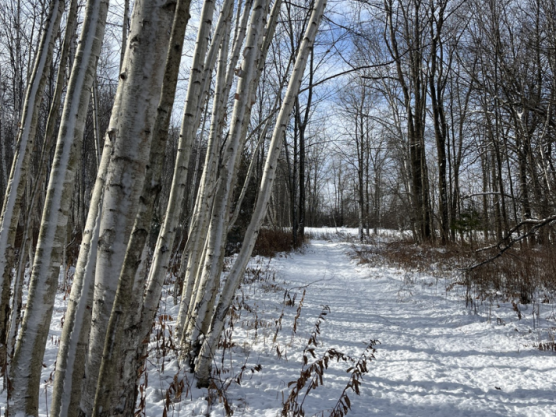 To the south of the main Christopher Farm & Gardens’ property lies the Turkey Trot Trails, a system of pathways along the Lake Michigan bluffs. With his Kubota Tractor, Mr. Jay Christopher carved out the initial paths on the undeveloped land in 2005 and named the area Turkey Trot, as he frequently would see turkeys trotting along the freshly cut paths. This area is a natural buffer zone between farm fields that lie to the west of the lake, providing a safe zone for local wildlife. This area experienced a gradual invasion of aggressive, non-native plant species in the past, which are now being managed and removed by our team. These managed areas are being revived more each year with plantings of native plant and tree species. The goal is to continue restoring this land to its original native plant community, where wildlife can thrive.
An agricultural pond was established as a boundary between a westward farm field and the trail system. This pond is frequented by migrating songbirds and waterfowl in both the spring and fall, though those are not the only migrators to stop by the Turkey Trot Trails. On one occasion, thousands of dragonflies were seen in mass moving through the trail system, stopping by the pond to find food, and then continuing their migration journey. It is major migratory events like this that show us how crucial habitats like these are for all types of creatures that must make the annual trip. This area provides food for migrators, as well as for the year-round animal residents. The tracks of many animals have been recorded in this conservation area even in winter. Though the trails are named for the abundance of turkeys seen trotting through, we have also seen coyote, opossum, raccoon, squirrel, pheasant, turtle, mink, whitetail deer, mice, mole and vole tracks along the trails.
These trails are maintained by our Land Conservation Manager, Robert Pragalz. He leads the charge on the planting of native plant plugs throughout the year, the seeding of prairie areas along the trail system, and the ongoing removal of invasive species. Planning and executing the management of this Turkey Trot Trail system, along with our other conservation areas, is no small feat! By Robert’s direction and efforts over the past several years, species of trees reintroduced to the Turkey Trot Trail land include white pine, birch, oak varieties, hazelnut, American plum and cedar. Shrub and prairie plant species that have been planted as plugs include snow berries, nine bark, elderberry, buttonbush, wild quinine, golden rod varieties, aster varieties, and milkweed. As these plants have grown and become more established, this conservation area has developed into a haven for native wildlife once again. Along with help from Christopher Farm & Gardens staff, these conservation efforts are also aided by the local Sheboygan County Cancer Care Fund’s members. This outstanding group of cancer survivors gather each April, right around Earth Day, to help us plant several types of native species. Hundreds of trees and plants have been added to this area over the years thanks to this amazing group of caring individuals.
Outdoor Education
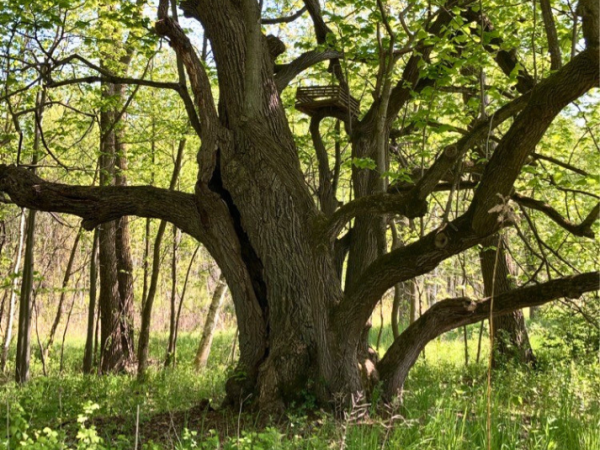 Students on field trips are occasionally taken on guided, educational hikes through this trail system. Young learners can experience a natural setting along Lake Michigan, something that has become increasingly hard to come by. As more modern developments pop up along the shoreline, these slices of native environments become fragmented and sparse. It is our goal to continue to manage and preserve these conservation areas both for the health of our local wildlife, and to provide educational opportunities for visiting school groups. This basswood tree, named "Merlin", is well-known and loved by visiting students for its regal presence at the heart of the Turkey Trot Trail system. Students can learn about Merlin and other native plants' seasonal adaptations by attending our “All About Autumn” field trip. Our “Wonderful Winter Wander” program also features a hike, exploring the shifts in local wildlife behaviors, which is discovered through animal tracking along the snowy trails, followed by a visit to our Nature Studies Center.
The Turkey Trot Trails are private property and may only be accessed via permission from the owner for pre-planned activities such as participation in a scheduled educational program. To schedule a visit, please use our Contact page to get in touch.